| Copyright© by Barry Truax (Handbook for Acoustic Ecology). | ||
As increasingly noisy environments threaten the aural health of more and more people, it is becoming increasingly important to understand the basic structure and function of the ear, and the threat to its proper functioning that noise exposure creates. This information is organized in five major topics:
Concerned with, and related to, the mechanics of the EAR and the organs of hearing, such as the auditory nerve. It is also used to refer to that which is perceived through, or results from the sense of hearing. Similar, but archaic, terms include: audient, auditive, auditual.
Compare: ACOUSTIC, AURAL. See: AUDIOLOGY.
(Latin: auris = ear) Experienced through or by means of the ear. Aural perception involves both hearing and listening abilities.
Compare: ACOUSTIC, AUDIO, AUDIOCENTRIC, AUDITORY, CLAIRAUDIENCE.
The study of the hearing process and hearing disorders, usually with an emphasis on speech perception. See: AUDIOLOGIST, AUDITORY.
Compare: AUDIOMETRY, HEARING LOSS, OTOLOGY, PHONETICS.
One who specializes in the study and treatment of hearing impairments.
Compare: ACOUSTICIAN, AURIST.
An early name for a person who studied diseases of the ear.
See: AUDIOLOGIST, AUDIOLOGY, OTOLOGY.
The branch of medicine concerned with the EAR.
See: AUDIOGRAM, HEARING LOSS. Compare: AUDIOLOGY, AUDIOMETRY.
The measurement of hearing ability, usually with the aid of an AUDIOMETER.
See: AUDIOGRAM, HEARING LEVEL.
Some aspects of audiometry concern an individual's sensitivity (see THRESHOLD OF HEARING) or tolerance (see THRESHOLD OF PAIN); others determine discrimination levels (see DIFFERENTIAL THRESHOLD), the ability to distinguish speech from background noise (see COCKTAIL PARTY EFFECT), or the ability to recognize pitch. In general, audiometry can measure the results of some types of HEARING LOSS.
An instrument for measuring hearing sensitivity. Since most audiometers use PURE TONEs, they are sometimes called pure tone audiometers. Early versions of the device were the sonometer and acoumeter.
See: AUDIOGRAM, AUDIOMETRY.
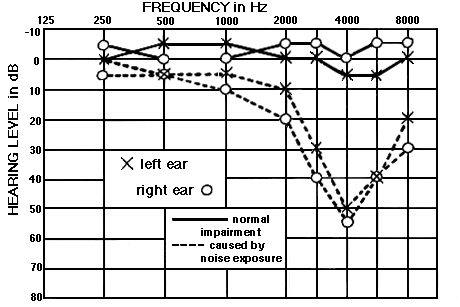
A graph showing HEARING LOSS as a function of FREQUENCY as measured by an AUDIOMETER. 0 dB on an audiogram denotes the hearing threshold level regarded as the normal audiometric standard at that frequency (see EQUAL LOUDNESS CONTOURS). Points below 0 on the scale denote louder threshold levels, whereas those above, expressed in negative decibels with respect to the zero level, are less intense levels which, because of individual hearing differences, some people may normally hear.
See: DAMAGE-RISK CRITERIA, DECIBEL, HEARING LEVEL, THRESHOLD OF HEARING. Compare: PRESBYCUSIS.
A typical audiogram comparing normal and impaired hearing. The dip or notch at 4 kHz as shown, or at 6 kHz, is a symptom of noise-induced hearing loss.
 Sound
Example: The above sentence heard with a simulation of normal, then
impaired hearing of the type illustrated in the diagram.
A measured value of an individual's THRESHOLD OF HEARING, expressed in DECIBELs, relative to a specified audiometric standard.
Hearing of speech is considered to be impaired when the hearing level is shifted 25 dB or more, averaged over the 500, 1000 and 2000 Hz frequencies (the region most critical in speech perception). The total impairment level is 1.5 times greater than that for speech. This measurement is not concerned with PRESBYCUSIS, which tends to be considered 'normal'.
See: AUDIOGRAM, AUDIOMETRY, HEARING LOSS, THRESHOLD SHIFT. Compare: INTENSITY LEVEL, LOUDNESS LEVEL, NOISE LEVEL, PERCEIVED NOISE LEVEL, SOUND LEVEL, SOUND PRESSURE LEVEL.
The organ of hearing, consisting of the outer ear (AURICLE and PINNA), the MIDDLE EAR (OSSICLES) and the INNER EAR (COCHLEA).
See also: AUDIOLOGY, EARDUM, HEARING LOSS, ORGAN OF CORTI, OTOLOGY, THRESHOLD OF HEARING, TRANSDUCER.

The part of the outer ear which projects from the side of the head and receives sound waves, the ridges of which are called the PINNA. See diagram under EAR.
The EARDRUM, also known as the tympanic membrane, whose vibration created by incoming SOUND PRESSURE variations is transferred to the bone structure, the OSSICLES, of the middle ear.
See: EAR, THRESHOLD OF HEARING.
A membrane stretched across the inner end of the external auditory canal. Vibrations in the air are picked up by the eardrum and are passed on to the bones of the MIDDLE EAR. Also called TYMPANUM, or tympanic membrane.
See: EAR, SOUND PRESSURE, THRESHOLD OF HEARING.
The air-filled cavity containing the OSSICLES which conduct sound vibration from the EARDRUM to the INNER EAR.
See: CONDUCTIVE HEARING LOSS, EAR , IMPACT SOUND.
Three tiny bones in the MIDDLE EAR - the malleus, incus and stapes, also known as the hammer, anvil and stirrup - which conduct sound to the INNER EAR. The malleus is connected to the EARDRUM and the stapes to the oval window of the inner ear. The incus joins the other two. See diagram under EAR.
See also: CONDUCTIVE HEARING LOSS, IMPACT SOUND. Compare: BONE CONDUCTION.
The third and innermost part of the ear which analyzes incoming sound into its component frequencies and produces neural impulses which are carried by the auditory nerve to the brain. HEARING LOSS in the inner ear is usually permanent.
See: PRESBYCUSIS, SENSORY-NEURAL HEARING LOSS. Compare: TRANSDUCER.
The inner ear consists of the COCHLEA and SEMICIRCULAR CANALS, embedded in the hardest bones of the head, and which contain the cochlear fluid, the BASILAR MEMBRANE and ORGAN OF CORTI, as shown in the diagrams under COCHLEA and EAR.
See also: BONE CONDUCTION, OSSICLES, VESTIBULE.
The spiral-shaped chamber within the INNER EAR. The conversion of the mechanical energy of a sound into electrochemical energy for transmission to the brain is performed in the cochlea by the BASILAR MEMBRANE and the ORGAN OF CORTI.
See: HEARING LOSS, SEMICIRCULAR CANALS, SENSORY-NEURAL HEARING LOSS, VESTIBULE, VOLLEY THEORY. Compare: TRANSDUCER.

A sectional view of the cochlea (after S. Stevens, Sound and Hearing, p. 42). Arrows show the direction of the cochlear fluid. The organ of Corti area, circled in the cochlea diagram, is enlarged below to show the detail of the hair cells.

The fluid-filled part of the INNER EAR that serves as the antechamber to the COCHLEA prior to the splitting of the tympanic and vestibular canals.
See EAR and COCHLEA for diagrams.
Three fluid-filled loops in the INNER EAR, attached to the COCHLEA and sensitive to movements of the head. They serve no hearing function but are an essential part of the body's balancing mechanism. See EAR for diagram.
Together with the ORGAN OF CORTI, the main sensing mechanism of the ear. It is contained within the fluid-filled COCHLEA of the INNER EAR, and is approximately 1.3 inches (35 mm) long, coiled 2 1/2 times in a spiral. See COCHLEA for diagram.
Incoming vibrations set up a travelling wave along the membrane giving it a different maximum displacement for different frequencies as shown below. The bulging of the membrane creates a shearing motion for the hair cells of the organ of Corti, generating electrical potentials that stimulate the auditory nerve.
See also: CRITICAL BANDWIDTH, THRESHOLD SHIFT, TRANSDUCER, VOLLEY THEORY. Compare: BONE CONDUCTION.

The bulging of the basilar membrane as a function of frequency (from F. Winckel, Music,Sound and Sensation, Dover, 1967, p. 90, used by permission; after L.A. deRosa, J.A.S.A, 1947, p. 623).
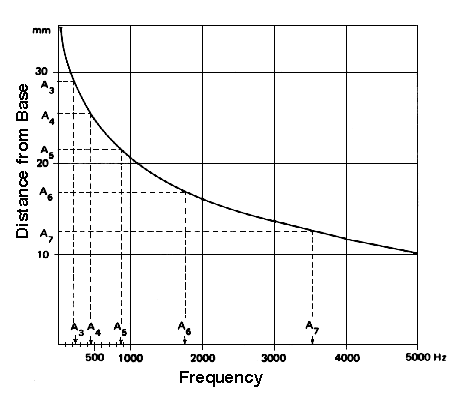
Position of the resonance maximum on the basilar membrane (after von Békésy) for a pure tone of frequency f. The figures A3 to A7 indicate the equivalent pitch positions in the western equal tempered scale; see Appendix C for further detail (from Roederer, Introduction to the Physics and Psychophysics of Music, Springer, 1975, p.22, used by permission). This spacing provides the basis for the logarithmic perception of frequency. See: LINEAR.
The part of the INNER EAR which is excited by the bulging of the BASILAR MEMBRANE. The nerve ends connected to the sensory hair cells transmit the excitation in the form of nerve impulses to the brain. See diagrams under COCHLEA, EAR.
See: ACOUSTIC TRAUMA, SENSORY-NEURAL HEARING LOSS, THRESHOLD SHIFT, TINNITUS, VOLLEY THEORY.
An hypothesis about the functioning of the nerves in the ORGAN OF CORTI in response to excitation. Since each nerve fibre can transmit only up to about 1000 impulses per second, two or more nerves must combine and synchronize their firing of impulses into order to encode all of the incoming information, particularly high frequency stimuli.
See: BASILAR MEMBRANE, COCHLEA.
Sound, particularly in the low frequency range, may reach the INNER EAR via the bones in the head rather than from the EARDRUM, this phenomenon being called bone conduction. The normal process via the ear canal is called air conduction. Wearing earplugs results in a greater percentage of the sound heard coming from bone conduction.
Normally only a small fraction of sound is received in this way; however, deaf people whose inner ear still functions normally may be able to hear sound conducted to the ear in this way, for instance by holding between the teeth a wooden rod connected to a vibrating object.
Compare: BASILAR MEMBRANE, CONDUCTIVE HEARING LOSS. See also: BONE CONDUCTION HEARING LEVEL.
The THRESHOLD OF HEARING measured by BONE CONDUCTION excitation, and expressed in DECIBELs relative to that specified as normal. The excitation of the bones of the head is realized with the use of a bone vibrator.
Decreased auditory perceptive ability. Such loss may be temporary (see ADAPTATION, THRESHOLD SHIFT), chronic or permanent (see ACOUSTIC TRAUMA), and may occur in various ways:
These and related ailments (see ACOUSMA, DIPLACUSIS, HYPERACUSIS, RECRUITMENT, TINNITUS) are dealt with by a branch of medicine called OTOLOGY, and are largely the result of problems in the MIDDLE EAR and INNER EAR (see COCHLEA, ORGAN OF CORTI).
Hearing loss, which is always acquired, should not be confused with deafness (anacusis) which refers to the complete inability to hear and is often congenital.
See also: AUDIOGRAM, AUDIOLOGY, AUDIOMETRY, CONDUCTIVE HEARING LOSS, HEARING LEVEL, OTOLOGY, SENSORY-NEURAL HEARING LOSS, SPEECH INTERFERENCE LEVEL.
Sound
Example: A simulation of normal and impaired hearing as a result of
noise exposure.
Hearing impairment due to an abnormality of the functioning of the INNER EAR, the auditory nerve, or both. The most common form of this impairment involves a degeneration of the hair cells attached to the ORGAN OF CORTI, a condition which cannot be reversed. However, the recently developed cochlear implant is an electronic device which attempts to simulate the sensory-neural function of the hair cells and restore some degree of hearing acuity.
See: ACOUSTIC TRAUMA, HEARING LOSS, OTOLOGY, PRESBYCUSIS, RECRUITMENT. Compare: CONDUCTIVE HEARING LOSS.
Impairment of hearing due to interference with the acoustic transmission (air conduction) of sound through the outer and MIDDLE EAR. Conductive hearing loss can often be repaired through surgery.
See: HEARING LOSS, OSSICLES, OTOLOGY. Compare: BONE CONDUCTION, SENSORY-NEURAL HEARING LOSS.
Permanent HEARING LOSS through deterioration of hair cells in the ORGAN OF CORTI. Such damage usually results from brief exposure to intense noise (see IMPACT SOUNDs), in particular those of high frequency.
Frequencies in the 4000 Hz range are the most dangerous, since an exposure of only five to ten minutes at 120 dB may produce a THRESHOLD SHIFT (TS) of 40 dB. The range of TS in excess of 40 dB is said to be the region of possible acoustic trauma. In addition to the occupational hazards of industrial noise, recreational exposure to heavily amplified music can also be serious enough to produce acoustic trauma.
See: DAMAGE-RISK CRITERIA, HYPERACUSIS, OCCUPATIONAL DEAFNESS, SOCIOCUSIS, SENSORY-NEURAL HEARING LOSS. Compare: PRESBYCUSIS, RECRUITMENT, THRESHOLD OF PAIN, TINNITUS.
Also spelled presbycousis, presbyacusis. The condition of HEARING LOSS specifically ascribed to aging effects. The greatest loss takes place in the higher FREQUENCY range, as shown on the graph.
See: AUDIOGRAM, HEARING LEVEL. See also: ORGAN OF CORTI, PINNA, RESIDUE, SIBILANCE, TRANSIENT.
The question of whether this loss may be ascribed to noisy modern living conditions, rather than to natural aging effects, has been controversial, particularly since Samuel Rosen's publication, "Presbycusis Study of a Relatively Noise-Free Population in the Sudan," American Otological Society, Transactions, vol. 50, 1962, pp. 135-152. Rosen discovered almost no signs of presbycusis among the Mabaan tribe of the Sudan and attributed this to their quiet living environment and generally healthy condition.
Compare: ACOUSTIC TRAUMA, HYPERACUSIS, NOISE POLLUTION, OCCUPATIONAL DEAFNESS, RECRUITMENT, SENSORY-NEURAL HEARING LOSS, SOCIOCUSIS, THRESHOLD SHIFT, TINNITUS.


Presbycusis curves for women and men, showing the average threshold shift for pure tones as a function of age (from ASA Subcommittee Z24-X-2, "The Relations of Hearing Loss to Noise Exposure," New York, 1954, pp.16-17).
HEARING LOSS due to prolonged exposure to NOISE in daily work. The degree of deterioration may be measured by an AUDIOMETER and displayed on an AUDIOGRAM.
See also: DAMAGE-RISK CRITERIA, THRESHOLD SHIFT. Compare: ACOUSTIC TRAUMA, BOILERMAKER'S DISEASE, NOISE POLLUTION, PRESBYCUSIS, SOCIOCUSIS.
HEARING LOSS from non-occupational NOISE exposure. In addition to actual damage to the auditory mechanism, research has revealed that noise may contribute to loss of sleep, tension, headaches, reduced vision, sexual impotence, heart disease and mental illness. These in turn contribute to more complex psychological and social problems.
Compare: HYPERACUSIS, NOISE POLLUTION, OCCUPATIONAL DEAFNESS, PRESBYCUSIS, THRESHOLD SHIFT.
Ref.: Alexander Cohen et al., "Sociocusis - Hearing Loss from Non-Occupational Noise Exposure," Sound and Vibration, 4:11, November, 1970.
A hearing impairment caused by exposure to high intensity broad band noise over long periods of time, and usually characterized by a loss of hearing to high frequencies and difficulty in understanding speech. See: HEARING LOSS.
The making of boilers during the early days of the Industrial Revolution first produced this affliction among workmen in these factories, and by analogy it has come to refer to any form of industrially-induced hearing loss.
Compare: PRESBYCUSIS, SOCIOCUSIS. See also: AUDIOGRAM, DAMAGE-RISK CRITERIA, NOISE POLLUTION, OCCUPATIONAL DEAFNESS, THRESHOLD SHIFT.
A nonverbal auditory hallucination, such as a ringing, buzzing or hissing. Also spelled acouasm or acosm.
Compare: HEARING LOSS, TINNITUS.
A ringing sound heard in the ear, commonly caused by prolonged exposure to loud sound, or even short exposure to very loud sound. It may be temporary or chronic, and may occur as the result of taking drugs such as aspirin. It is thought to be produced by a spontaneous firing of the hair cells in the ORGAN OF CORTI.
Compare: ACOASMA, ACOUSTIC TRAUMA, DIPLACUSIS, HEARING LOSS, HYPERACUSIS, PRESBYCUSIS, RECRUITMENT, THRESHOLD SHIFT.
A type of SENSORY-NEURAL HEARING LOSS where the range of normal or comfortable hearing, between the inaudible and the too loud, is reduced.
In some instances the growth in loudness of a sound is so great as to cause DISTORTION, MASKING, unintelligibility and, with very loud sounds or IMPACT SOUNDs, a THRESHOLD SHIFT that may take several days to return to normal.
See: HEARING LOSS. Compare: ACOUSTIC TRAUMA, DYNAMIC RANGE, HYPERACUSIS, PRESBYCUSIS, TINNITUS.
An aural deficiency in which the PITCH of a single TONE is heard doubly (i.e., as two different pitches) by the two ears. The cause of this phenomenon is a loss of sensitivity in one ear in a certain frequency RANGE, thus causing it to perceive pitches differently.
See: DISTORTION. Compare: HEARING LOSS, TINNITUS.
A painful sensitivity to loud sounds.
Compare: ACOUSTIC TRAUMA, HEARING LOSS, PRESBYCUSIS, SOCIOCUSIS, THRESHOLD SHIFT. See also: LOUDNESS, RECRUITMENT, SOUND PHOBIA, THRESHOLD OF PAIN, TINNITUS.
Abbr. for Occupational Safety and Health Administration in the U.S. Dept. of Labour, and for the Occupational Safety and Health Act (1970).
See: DAMAGE-RISK CRITERIA.
Recommended maximum NOISE LEVELs for given exposure periods, such that OCCUPATIONAL DEAFNESS is minimized. The following table shows the levels adopted in 1971 by the Occupational Safety and Health Act (OSHA) in the U.S.A. for noisy industrial environments. These recommendations have also been accepted by Workers' Compensation Boards in Canada. However, the levels are approximately five decibels above those recommended by the American Otological Association.
See: ACOUSTIC TRAUMA, HEARING LOSS, THRESHOLD OF PAIN, THRESHOLD SHIFT.
The First Draft Amendments, October 1974, of the Workers' Compensation Board of B.C. replaced these criteria (sound level - hours per day) with a standard that would specify graded types of hearing protection (earmuffs, earplugs, fiber batting) to be worn by workers in areas where the sound level exceeds 85 dBA for any period of time.
PERMISSIBLE NOISE LEVELS
Duration per Day |
Sound Level |
8 |
90 |
6 |
92 |
4 |
95 |
3 |
97 |
2 |
100 |
1 1/4 |
102 |
1 |
105 |
1/2 |
110 |
1/4 |
115 |
Exposure to impulsive or impact noise should not exceed 140 dB peak sound pressure level
Permissible noise levels in dBA established by the Workers' Compensation Boards in North America for industrial noise exposure.
The simple decibel level used does not take into consideration the frequency BANDs in which the sound energy is concentrated (and certain of these, from 1 to 4 kHz, present greater hearing danger), INFRASONIC vibrations, AMPLITUDE MODULATION effects, time variation in sound levels, IMPACT SOUNDs, etc. All of these factors may cause annoyance and create a potential health hazard. See also: EQUIVALENT ENERGY LEVEL.
Recent investigation has shown that average sound levels are not an adequate indicator of hearing risk. Instead, the impulsive character of the sound, in addition to its average intensity level, must be considered. This has been ignored in the past because, first of all, most SOUND LEVEL METERs, even with fast response modes, have an averaging time of about 125 ms, whereas impulse peaks in many sounds occur within 25-50 microseconds. Therefore these meters are unable to measure the true intensity level of such sounds. Moreover, the averaging time of the brain is about 35 ms, and therefore these impulses are actually more intensive than they appear to be based on LOUDNESS. This may be verified by noting that short impulses sound less loud than longer ones of the same intensity. See: CLICK.
The increased risk to hearing arises because, first of all, these impulses are transmitted with full force to the INNER EAR (the averaging times of the outer and middle ears being 50 and 35 microseconds respectively). Moreover, as pointed out by P.V. Brüel, "short impulses with relatively high energy content around 4 kHz are almost always amplified by resonance in the outer and middle ear so that these impulses reach the inner ear with an amplitude 10 - 12 dB higher than other types of noise." This explains the characteristic 'notch' in an AUDIOGRAM that signifies the beginning of noise induced hearing loss (see diagram under AUDIOGRAM). Given this amplification, certain loud sounds may damage the nerve ends of the inner ear producing permanent hearing loss, even though a normal sound level meter would indicate that their level is lower than the danger level.
Brüel concludes that "we must not only determine the sound level with a normal sound level meter, but must furthermore determine the impulsive content of the noise with a sound level meter that can be charged up very quickly." Such a meter has a 'peak hold' circuit with an averaging time of 30 microseconds. When various sounds are measured with such a meter, it is found that certain ones have very high peak levels compared with fast dBA or dBA impulse hold levels, and therefore these pose a greater hearing risk than those without such impulses.
The worst cases are all impact sounds, metalworking machines (punch presses, nailing machines) and bottling machines. More common domestic sounds that fall into this category are lawnmowers, typewriters, electric shavers, interior car noise and clicks in telephone circuitry. Amplified music, on the other hand, does not contain harmful peaks because of dynamic COMPRESSION. Therefore, hearing loss from exposure to loud music, although significant, is not as extensive as the high levels would normally lead one to predict on the basis of levels alone. The damage-risk criteria that have been suggested to take impulsive content into consideration are shown below.
Ref.: P.V. Brüel, "Do We Measure Damaging Noise Correctly?", B&K Technical Review, no. 1, 1976, pp. 3-32.
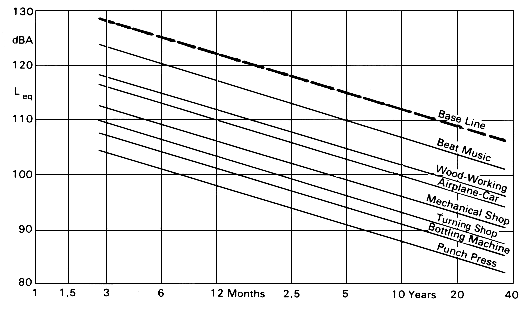
Risk limits of hearing loss (50% probability) for different types of noise, evaluated on the basis of the relation between dBA and Peak value. The lower the line, the higher the risk because of impulsive content (from Brüel, B&K Technical Review, no. 1, 1976, p. 20, used by permission).
Sound Source |
Fast dB(A) |
Imp. dB(A) |
Imp. Hold dB(A) 5x |
Peak Hold dB(A) 5x |
D |
| Sinusoidal pure tone 1000 Hz | 94 |
94 |
94 |
97 |
3 |
| Beat music from a gramophone | 90 |
91 |
93 |
97 |
4 |
| Modern music from a gramophone | 102 |
103 |
103 |
105 |
2 |
| Electric guitar from a gramophone | 85 |
86 |
86 |
91 |
5 |
| Motorway traffic, 15m distance | 80 |
80 |
81 |
89 |
8 |
| Motorway traffic, 50m distance | 68 |
68 |
68 |
76 |
8 |
| Train 70 km/h rail noise, 10m distance | 95 |
96 |
98 |
106 |
8 |
| Train 70 km/h rail noise, 18m distance | 85 |
87 |
87 |
94 |
7 |
| Noise in aircraft Type PA 23, cruising speed | 90 |
91 |
91 |
100 |
9 |
| Noise in aircraft Type Falco F 8, cruising speed | 97 |
98 |
98 |
109 |
11 |
| Noise in aircraft Type KZ 3, cruising speed | 102 |
102 |
103 |
112 |
9 |
| Noise in car Type Fiat 500, 60 km/h | 78 |
79 |
79 |
93 |
14 |
| Noise in car Type Volvo 142, 80 km/h | 75 |
75 |
76 |
86 |
10 |
| Lawn mower 10 HK 1m distance | 97 |
99 |
99 |
116 |
17 |
| Typewriter IBM (head position) | 80 |
84 |
83 |
102 |
19 |
| Electric shaver, 2.5m distance | 92 |
92 |
92 |
107 |
15 |
| 75 HK diesel motor in electricity generating plant | 100 |
101 |
101 |
113 |
12 |
| Pneumatic nailing machine, 3m distance | 112 |
114 |
113 |
128 |
15 |
| Pneumatic nailing machine near operator's head | 116 |
120 |
120 |
148 |
28 |
| Industrial ventilator 5 HK, 1m | 82 |
83 |
83 |
93 |
10 |
| Air compressor room | 92 |
92 |
92 |
104 |
12 |
| Large machine shop | 81 |
82 |
82 |
98 |
16 |
| Turner shop | 79 |
80 |
81 |
100 |
19 |
| Automatic turner shop | 79 |
80 |
80 |
99 |
19 |
| 40 ton punch press, near operator's head | 93 |
98 |
97 |
121 |
24 |
| Small automatic punch press | 100 |
103 |
103 |
118 |
15 |
| Numerically driven high speed drill | 100 |
102 |
103 |
112 |
9 |
| Small high speed drill | 98 |
101 |
101 |
109 |
8 |
| Ventilator with filter | 82 |
83 |
83 |
94 |
11 |
| Machine driven saw, near operator's head | 102 |
102 |
104 |
113 |
9 |
| Vacuum cleaner Type Hoover, 1.2m distance | 81 |
81 |
81 |
93 |
12 |
| Bottles striking each other | 85 |
88 |
90 |
105 |
15 |
| Bottling machine in brewery | 98 |
99 |
101 |
122 |
21 |
| Toy pistol (cap) | 103 |
108 |
108 |
140 |
32 |
| Pistol 9mm, 5m distance from side | 111 |
114 |
116 |
146 |
30 |
| Shotgun, 5m distance from side | 106 |
110 |
111 |
143 |
32 |
| Saloon rifle, 1m distance from side | 105 |
110 |
110 |
139 |
29 |
Table showing dBA and peak values measured for various sources. The difference between peak and dBA values, shown in the right-hand column, represents the degree of hearing loss danger caused by the impulsive characteristic of the source. The numerical amount in dB is that by which the damage-risk line must be plotted on the graph below the base line (reference as above).