| Copyright© by Barry Truax (Handbook for Acoustic Ecology). | ||
Because of its importance in communication, the study of language as both a communicational and acoustic system is highly developed. Here we touch on only the most basic definitions in each area.
The study of the entire speech process, not necessarily in the context of a given language. This discipline includes a study of the articulation, classification and perception of speech sounds (or PHONEs), as well as the physiological and neurological basis for speech generation. The linguistic application of phonetics relates it to PHONOLOGY.
The branch of PHONOLOGY concerned with the analysis of the sounds of a given language with the aim of transforming the spoken word into writing.
Compare: ORAL HISTORY, PHONETICS.
The study of pronunciation; the system of spoken sounds, especially in a particular language.
(Greek: phonema = sound) Any of a small set of units, usually about 20 to 60 in number, and different for each language, considered to be the basic units of vocal sound. They are arrived at in a given language by determining which differences in sound indicate a difference in meaning.
Compare: ALLOPHONE, MORPHEME, PHONE, PHONEMICS, PHONETICS, PHONOLOGY.
A speech sound, such as a simple VOWEL or CONSONANT sound, not to be confused with PHON.
See: PHONEME, PHONETICS. Compare: ALLOPHONE, MORPHEME.
Any of the minimal grammatical units of a language, each consisting of a word or meaningful part of a word, that cannot be divided into smaller grammatical parts, for instance 'the', 'speak' or the 'en' of 'spoken'.
Compare: ALLOPHONE, PHONEME, PHONE.
A speech sound constituting one of the phonetic variants of a given phoneme such as the different t-sounds of toe, tree, hatpin, catcall, catnip, button, city, etc.
Compare: MORPHEME, PHONEME, PHONE.
The speech sound produced by the VIBRATION of the vocal cords without any closure of the vocal tract above the glottis, as is the case with a CONSONANT. Since a whispered vowel is produced without a vibration of the vocal cords, it is called a voiceless or unvoiced vowel.
The quality of the vowel sound is determined by the size and shape of the oral and nasal cavities, the former of which is largely determined by the position of the tongue and lips.
The vocal tract serves to resonate the sound produced by the vibration of the vocal cords (see RESONANCE). If it were a symmetrical tube closed at one end and open at the other, it would resonate odd HARMONICs. Instead, because of its asymmetry, the resonant frequencies broaden into FORMANT regions which can be shifted higher or lower in frequency by the tongue position and aperture of the mouth.
Vowels are characterized by at least two formant regions, and are notated in the International Phonetic Alphabet (IPA) by letters in square brackets, e.g. [i], [e], [u]. See chart under FORMANT.
See: PHONE. Compare: CONSONANT, SIBILANCE, VOCAL STOP.
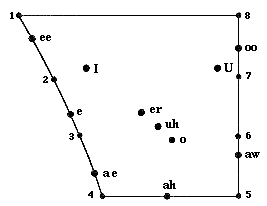
The vowel quadrilateral enclosing all possible tongue positions and on whose boundaries are the cardinal vowels numbered 1 to 8.
The pure vowels in English are indicated as follows:
ee |
heat |
I |
hit |
oo |
cool |
e |
head |
ae |
had |
o |
ton |
uh |
the |
ah |
father |
er |
bird |
aw |
call |
U |
put |
Diphthongs are vowels with shifting formant regions produced by a change in the shape of the vocal tract, in contrast to the pure vowels which are produced with a fixed vocal tract shape and tongue position. The five diphthongs in English are:
ou |
tone |
ei |
take |
ai |
might |
au |
shout |
oi |
toil |
(noun) A speech sound produced by some obstruction of the vocal tract above the glottis. The vocal cords are vibrated with some consonants, called voiced consonants (e.g. b, d, g, v); others are unvoiced or voiceless (e.g. p, t, k, f, s); still others may have both forms (e.g. th).
Consonants may be classified according to their manner of articulation (nasal, lateral, fricative, affricate, or as a VOCAL STOP); by their length (short, long); or by their point of articulation (bilabial, labiodental, interdental, dental, palatal, velar, uvular, pharyngeal, and glottal).
The BANDWIDTH of most consonants is more than an OCTAVE, and together their energy can range from 100 Hz to 10 kHz, as shown on a SONAGRAM. The perception of the higher consonants is affected by PRESBYCUSIS.
Compare: VOWEL. See: FORMANT, PHONE, SIBILANCE, TRANSIENT, TRILL.
As an adjective, the term refers to the quality of CONSONANCE.
A short break in vocalized sound preceding certain CONSONANTs (such as b, p, g) called plosives.
Compare: VOWEL.