When a number of waves of the same nature pass through a medium simultaneously, each wave travels through it as though the others were not present. However, at any instant, the waves reaching any point in the medium produce a net effect. This effect can be linear or non-linear.
We distinguish between superposition, when the addition of waves are of interest and Interference, when some of them are considered to contaminate a good one in which we are interested.
When two waves combine in a manner which simply adds their respective amplitudes linearally at every point in time, the superposition is said to be linear. In other words, 'if two or more waves of the same nature travel past a point of the medium, then the resultant displacement of the medium at that point is given by the vector sum of the displacements due to the individual waves.' If s1 and s2 are the individual displacements caused by two waves reaching a point, then the resultant displacement is given by s = s1 + s2. An alternative statement of the law is that two or more waves may propagate in the same space simultaneously, the resultant pressure variation at any point being the algebraic sum of the instantaneous pressure variations of each component wave.
Linear superposition holds good in the case of waves of small amplitude in an elastic medium and electromagnetic waves. But, for example, not in the case of shock waves produced by large explosions.
Linear superposition of two waves can be studied in several cases, giving rise to the formation of different patterns:
From the last case, we can build any complex wave by mixing together different simple waves (sinusoidal waves) of various amplitudes (see Sound Synthesis). The reverse process by which we decompose any complex wave in an addition of simple sinusoidal waves is called Fourier Analysis.
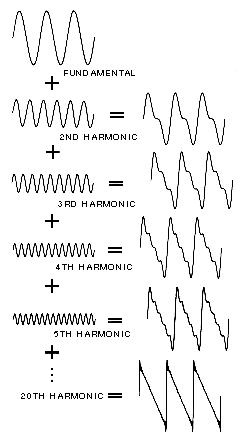
In the following figure we can see successive approximations of a sawtooth wave by addition of harmonics with amplitude inversely proportional to the harmonic number. The resultant waveform at each stage of addition is shown at right.
You can hear those successive approximations of a sawtooth wave resulting in the addition of the first 14 sine wave harmonics.
A (pure) sine wave can be defined exclusively by its amplitude, phase and frequency. In other words, a sine wave has only one frequency. On the other hand, any other wave shape can be decomposed as an addition of single sine waves of different frequencies, amplitudes and phases.
The graphical representation of a complex wave as a composition of sine waves (frequencies) with different amplitudes is called spectrum.
The spectrum can be discrete (the components are clearly separate and distinguishable) or continuous (the components are all together).
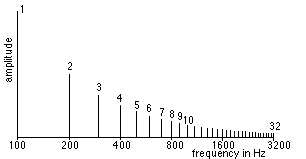
Discrete spectrum of a complex tone consisting of a fundamental and harmonics.
A simple sine wave may be said to be simple and all the rest may be said to be complex. However, usage of this term is not consistent, and some writers refer to a complex tone as one having more than one pitch, thereby emphasizing the perceptual dependence of the term. In that case, a sound may have many frequency components (such as any musical instrument note) but if it seems to have only a single pitch, it will not be called complex.
Sound Example: Complex tone (triangle wave).
Sound Example: Simple tone (sine wave).